.jpg)
.webp)

How to Set Up a Referral Program for Your Ecommerce Store in 6 Steps
Setting up a referral program should not be hard. Here's how you can do it in six steps and start getting referrals!

Here at ReferralCandy, we're excited to introduce something we've been working on: the Ecommerce Agency Industry Report!
Each month, we’re gathering information from ecommerce agencies: their results, thoughts, and predictions, and then sharing these insights in an aggregated and anonymous industry report.
Whether you're an agency owner or just looking for more information, this report can help you get a better understanding of the state of ecommerce agencies.
According to our April 2024 survey, despite a slight decrease in agencies' confidence, most agencies expect their revenue to continue growing and that merchants will continue using their services. To stand out, agencies can use marketing methods that bring high ROI, such as referral programs using software like ReferralCandy.
We will now discuss our findings about ecommerce agencies in more detail.
As part of our survey, we asked ecommerce agencies to rate their confidence level from 0 to 500, which we turned into the below Ecommerce Agency Confidence Index. This index is based on aspects like how confident they’re about customer acquisition, market saturation, and changing consumer behavior.
Based on our survey, here are the overall confidence levels reported by ecommerce agencies over the past months:

As you can see from the above graph, ecommerce agencies' confidence in the state of ecommerce has slightly decreased in the recent months.
We started the survey right after record-breaking Black Friday and Cyber Monday numbers at the end of 2023, and there’s an overall sense that things have gone slightly downhill from there.

We asked ecommerce agency owners: Has there been any increase in your customer’s marketing budgets?
To conclude the responses, marketing budgets haven't changed much, but advertising costs have increased, so customers want to allocate their budgets more wisely.
The increase in advertising costs over the past few months has had an effect on agencies that provide marketing services that can compensate for it.
As Stefan Chiriacescu, eCommerce Today Agency puts it:
Other agency owners like Daniil Andreev from ECORN Agency mentioned that although they “haven’t really seen a reduction”, their clients have allocated funds “differently, even if the total dollar amount hasn’t really changed.”

We asked ecommerce agency owners: On a scale from 0 to 10, how have your customers’ budgets for investments in ecommerce apps changed?
This is one of the most consistent responses we’ve had over the months. It is evident that ecommerce agency clients are willing to spend money on ecommerce apps, provided the app provides a positive return on investment.
Paul Rosenwald from SeaMonsterStudios has a great explanation for it:
As we mentioned, the real question is, is the app gonna show ROI? Can we track that we will make more money or become more efficient if we implement it?
Merchants are almost always budget conscious, but they are usually performance driven.”

We asked ecommerce agency owners: On a scale of 0 to 10, how would you rate the current price sensitivity of your customers towards spending on agency services?
This is probably one of the most important pieces of information for agency owners. How sensitive are merchants to agency prices? Are merchants trying to renegotiate contracts or retainers?
Although in February it looked like merchants were becoming more sensitive, in March we’ve seen this trend stabilizing.
Paul Rosenwald believes that the “real challenge for the merchant is to find the right agency to work with.“ Someone who can speak their language and work cohesively with their team.”
And although budget is usually part of the process, they have noticed that “the choice is based on finding the partner and being confident in that partnership.”

We asked ecommerce agency owners: How likely is it that your customers will bring their marketing teams in-house rather than outsourcing work to agencies in the upcoming months?
In February, there was an increase in uncertainty or diversity in predictions about clients' strategies. If we could summarize in one sentence, it would be “I’m not sure, but it doesn’t look great”.
This pessimism seems to have tamed down in March, with almost half of our agencies reporting no change in their customers’ outsourcing behavior.
This is one of the key aspects that determine the health of an ecommerce agency. Are their clients likely to continue outsourcing work to them? Or are merchants looking to bring their marketing in-house?
Ultan O’Callaghan from Thooja has learned to think of his team as a “department” within customers’ companies:

We asked ecommerce agency owners: On a scale of 0 to 10, how optimistic are you about your revenue increasing in the next six months?
The answer is that most agency owners believe their revenue will continue to increase.
If we could use one adjective to describe ecommerce agencies, it would be optimistic. Agencies continue to believe that it will be a positive year for them in terms of revenue.
As Paul Rosenwald from SeaMonster Studios mentions:

We asked ecommerce agency owners: On a scale of 0 to 10, how optimistic are you about the opportunities in ecommerce for the next 6 months?
To conclude the results for this question: Most ecommerce agencies see the next 6 months as an optimistic time period with new opportunities.
We believe that ecommerce agencies are the unsung heroes in the world of ecommerce. They’re the ones working closely with brands, crafting their online shopping experiences and, in many cases, doing the hard work so brands can focus on improving their products and services.
That's why their insights are pure gold. They have courtside seats to the world of ecommerce, and they see everything – the trends, the hits, and the misses.
This is what Jess Grossman, the founder & CEO of In Social, mentions about the importance of ecommerce agencies:
We also believe that agencies are sometimes forgotten when it comes to analyzing the evolution of the ecommerce industry. We focus on metrics like merchandise volume and customer acquisition costs, but we never gather data about ecommerce agencies' revenue or their customers' price sensitivity to their services.
We're setting our sights high with this industry report. We're not just content with understanding today's trends; we want to get a sneak peek into tomorrow’s. The idea is to track these insights over time and start predicting where ecommerce is headed.
This isn’t just number crunching; it’s about getting a sense of the human element behind the data.
This index gets better with more voices joining in. It’s a community thing – the more agencies chip in, the richer and more insightful this index becomes. It acts as a growing, evolving knowledge base for all of us in the ecommerce sphere.
Some of our agency participants include: SeaMonster Studios, Swanky Agency, Thooja, Audacious Commerce, Ecommerce Today, For My People, RPF Agency, Pluro, Webcetera, SmartBug Media, Gloross, VT Labs, Motif, TatJones, Growth Heist, MageMontreal, GetVisible, StubGroup, Thooja, Gudu, and SEOWorks.
If you're an agency and would like to participate and receive the full report, you can email ReferralCandy's Partnerships Lead Raul Galera at raul [at] referralcandy.com

.png)
One of the most common questions we get is, “How do I get more referrals?”
I went to ask the people who have all the secrets to generating referrals — our Customer Success Managers!
They oversee hundreds of merchant accounts each to help them get better results from their referral programs. To understand the state of merchants' referral programs and to find ways to optimize them, our Customer Success Managers go through a detailed checklist that they have refined over the years.
Ready to learn more? Let's get started on the checklist!
As usual, if you have any questions, feel free to ask us!
Note: If you haven't yet launched your own ecommerce referral program, you can do that easily with ReferralCandy! If you use Shopify, ReferralCandy is also available on the Shopify App Store.
Here is the 11-step client referral checklist you can follow:
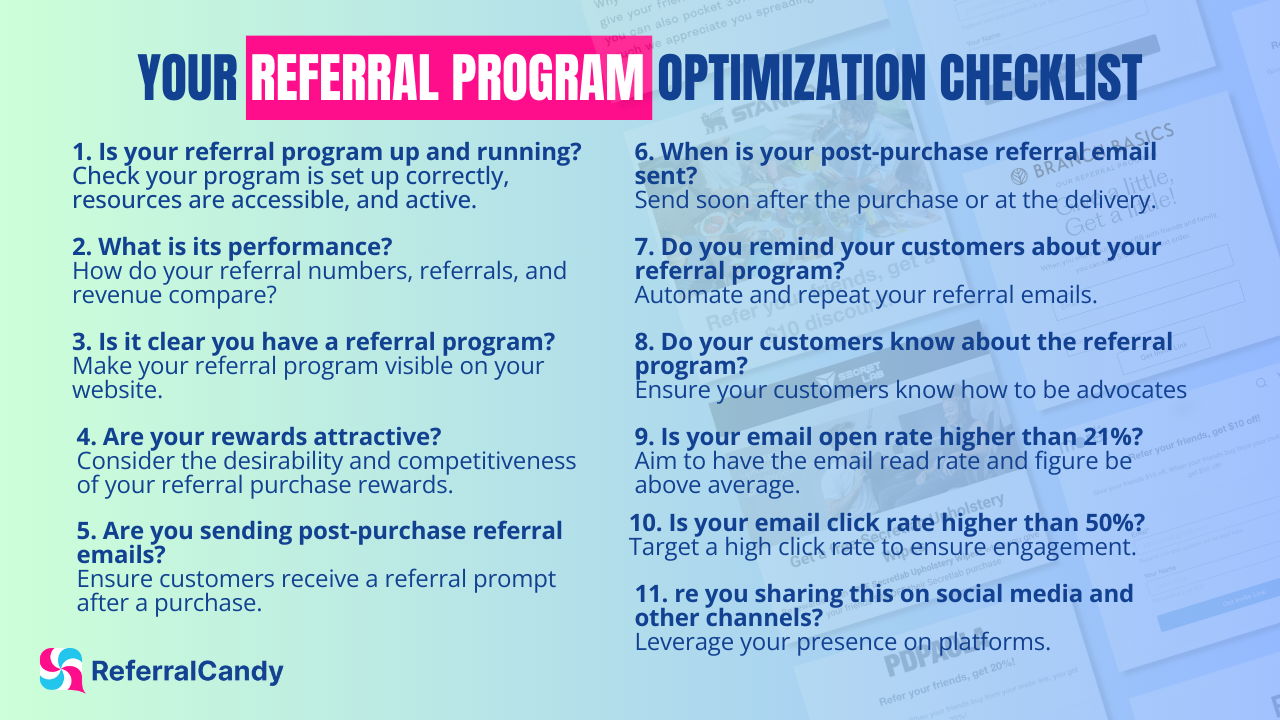
We will next go through the 11-step process in more detail.
As a first step, check the fundamental status of your referral program.
This might sound a little silly, but to get more referrals, you have to ensure your customer referral program is actually up and running.
You can see the status on your ReferralCandy dashboard.

Have you set your rewards and checked that they are valid? If you are using Shopify or BigCommerce, ReferralCandy will automatically create coupon codes for your referral program. For other platforms, you will need to create the coupon codes in your store platform and upload them to ReferralCandy.
If you are using integrations, are they working fine? For example, if you are using ReCharge for subscriptions, you would want to check that ReCharge is connected to your ReferralCandy account and you have the right settings in both ReCharge and ReferralCandy. You can refer to our help articles on integrations if you need any help.
Once you know your referral program is up and running smoothly, let's assess your referral results.

Note: When analyzing your referral program's performance, remember that all referral marketing revenue is new revenue as it comes from referred customers. This is different from other marketing methods, such as email marketing, which takes revenue from existing clients.
Therefore, calculating the return on investment is also different. We recommend you follow the next steps to calculate the return on investment on your customer referrals program!
To start, compare your referral rate with the industry referral rate, which you can see on your ReferralCandy dashboard. (Do remember to set your store industry under “Store Settings” to get the specific referral rate for your industry.)
ReferralCandy calculates your referral rate by dividing the number of referral transactions by the total number of transactions in your store over the past 30 days. In other words, the percentage of your sales that are from business referrals.
On your dashboard, you can see the number of referral sales, the value of referral sales, and the trend over the last 30 days.
There are several ways to make use of this data. You could compare your referral sales to your targets. Or you could compare your referral sales with the previous month. Or you could check that your referral sales are growing steadily or not declining.
A simple method is to divide your referral sales by your ReferralCandy subscription fee. For example, $2,000 of referrals divided by a $134 subscription fee is a 15-times return on investment.
For every $1 spent on ReferralCandy, you get about $15 back. (How does this compare to the costs and returns of your ads and other marketing channels?)
That said, this simplified calculation does not consider intangible benefits, such as more engaged customers and greater reach, and costs, such as cost of setup and maintenance.
At this point, how are you feeling about the performance of your referral program? If you want to get more referrals, read on for some ideas!
A key success factor of your referral program is the number of advocates who are recommending their friends. So you want as many people to know about your referral program as possible to get more client referrals.
We recommend merchants highlight their referral program on their homepage.
For example, Bees & Trees link to their customer referral program from their home page:

Other merchants choose to highlight their customer referral programs on their carousel images or in their footer, as Vinyl, Me Please does.

This will remind already loyal customers of your referral program and encourage new visitors to sign up for your it.
Your advocate reward and friend offer has to be attractive enough for your customers to refer their friends. The key is to align them to your customers' motivation—what do they want from buying from you?
Here are a few rules of thumb that our Customer Success Managers use:
For your advocate reward:
For your friend offer:
If you do not want to offer discounts or cash rewards, you can also be creative about your rewards. For example, ThreadBeast, a men's streetwear brand, gives its advocates a free package of streetwear for referring their friends.
Your post-purchase referral email is the primary way that customers learn about your referral program. Also, people most likely cannot remember their referral link. Having this email in their inbox gives them something to refer to.
If you are worried about sending your customers too many emails, you can grab the link to your referral program from your dashboard and include it in your usual emails to your customers.

Also, if you need help with designing your post-purchase emails, you can take inspiration from our email design examples article.
Our Customer Success Managers recommend sending the post-purchase referral email immediately after a customer's purchase.
We see higher engagement with referral emails if it was sent immediately after purchase rather than a couple of days later. This is likely because customers are already looking out for the confirmation email so they are more likely to interact with the referral email.
In ReferralCandy, you can customize when the post-purchase referral email is sent.

You should also experiment with other timings. For example, Riff Raff and Co sends their post-purchase emails when their customers receive the products and follows up again eight weeks later.
Reminding your customers about your referral program is a good way to keep it top of mind. ReferralCandy can automatically send regular reminder emails for you. You can set how often to send reminder emails and when to stop sending them.

We personally do not like spammy or aggressive emails. Thankfully, reminder emails are programmed to space out if the customer is not opening them. And we will eventually stop sending the customer your reminder email altogether. (But if the customer is opening the reminder emails, they likely would not mind receiving them.)
All emails have an unsubscribe button at the bottom so that your customers can opt-out at any point in time.
You can edit your reminder emails by going to Referral Program > Emails & Pages > Edit (your theme) > Content > Reminder Email > Edit.

Once you set up ReferralCandy, new customers will be invited to your referral program, such as via your post-purchase email. But you might also want to let your current customers know about your referral program.
Satisfied customers who have supported you in your early days or who have bought a few times from you are very likely to be strong advocates for your brand.
In ReferralCandy, you can upload a list of your customers and email them an invitation to your referral program. (You can also import your list from Mailchimp if you are using either for your email marketing.)

If you have just launched your referral program, your current customers are a great source of initial business referrals.
You can see your email open rate right on your dashboard.

According to Omnisend, the average open rate for all industries is about 21%.
If your email open rate is lower than your industry's average, we would recommend you experiment with different subject lines. Our Customer Success Managers usually recommend you highlight the benefit to both advocates and friends.
Here are some subject line variations you could try:
You can calculate your email click rate by dividing the number of referral link clicks by the number of referral email views.

We generally see much higher click rates than Mailchimp's benchmarks. This might be because the referral reward makes people more likely to click. Our Customer Success Managers usually aim to get click rates to more than 50%.
Here are some things to consider when improving your email content:
We also have a guide on how to write referral emails, which includes referral email design examples.
Marketing is all about being where your customers are and adding value to their lives.
If you have an active presence on social media and your audience is engaging with your posts, it might be great to let them know about your referral program there. On ReferralCandy, there's an option to customize your social media messages so that it fits each social media platform you intend to share on.

Or if you also have a retail store, you could tell your customers about your referral program verbally or with a small leaflet, asking them to sign up on your website.
No worries! Our Customer Success Managers are eager to help.
P.S. If you found this article helpful, you might like our newsletter. :)
If you're looking for more detailed articles on improving your existing business referral program, here are some insightful resources:
The initial version of this article was written by Visakan Veerasamy, ReferralCandy's former blog editor (2013–2018).


Referral emails are a successful strategy that ecommerce and DTC brands employ to promote their referral programs to their advocates and improve referral rates.
Sending out referral emails to your happy customers not only brings your loyal customers back to your online shop but also brings in new customers with little effort (thank you, email automation).
Once you've decided on the referral incentives for your existing customers, it's time to let them know about it by sending out a well-thought-out referral program email.
In this article, we'll give you tips for writing the best referral emails, show you what other successful ecommerce brands are doing and give you three templates to use.
Let’s start with quick tips!
Note: The below examples can serve as great inspiration for your own referral emails. If you want to start actually building your own referral emails, you can use referral program software such as ReferralCandy.
Even with the most irresistible incentive possible, it doesn't necessarily equate to your customers taking up your offer.
Why not?
Because they might not even open your referral program email. If they do, they might not click on the link to set up their referral discount or offer.
That's why it's super important to write a referral email that is more likely to land in the inbox, be opened, and grab the attention of your existing customer base.
"It only takes a few seconds for customers to decide whether to click on your referral email, so make it stand out. Maximize your chances of higher open rates by using an eye-catching subject head, professional-looking images that highlight your product, and use persuasive, but not aggressive copywriting." - Rachel Leung, Product Designer @ ReferralCandy
We've got a few tips to help you do exactly that.
As tempting as it is to write a super cheeky subject line as you might do with your friends, it might not be the best tactic when it comes to your email marketing strategy.
Instead, it's super important to be clear about what you are offering in the email so that your customers know whether or not they want to open it. Be clear about what the referral offer is right in the subject line (see example below).
Email subject line example: Get 10% off your next purchase and help a friend save too!
Want another tip?
Consider adding an emoji to your subject line. People are 54% more likely to open your email when there are emojis in the subject line.
Referral incentives are one of the most important components of asking for referrals. Most people want to know what's in it for them by referring your brand and product to their close friends and family.
The keyword here is “WORTH”.
The referral incentive should be clear and simple while showing your subscribers that it is worth being an advocate for your brand. By prominently displaying it in your email, it helps your customers to decide if it is worth their time and effort to refer your brand and products.
Showing the incentive example:
To refer a friend, simply share your unique referral code/referral link with them and have them enter it at checkout. They'll get 10% off their order, and you'll get a discount on your next purchase.
Listen, as impressive as human beings can be at times, the truth of the matter is that we are also incredibly lazy.
So make your referral bonus easy to identify right away, either with a clear call-to-action, an effective campaign slogan, a big, bold referral code, or super clear instructions. You want to include a unique referral link for customers to copy. This can be shared on both the referral email and referral program page.
A good email design ensures that the main message is read even if your customer is just scanning through the email. Furthermore, custom email templates play a pivotal role in attracting the customer's attention and nudging them to act.
When starting your referral program, you must determine who you will send it to, i.e., your target audience.
For most ecommerce merchants, we recommend sending the referral program email to all new customers with a post-purchase email, which we’ll discuss in the next step.
You should send it not only to all new customers but also to existing customers. To do this, you can use one of the email templates we will later show you in this article.
Once you have identified your target audience, the next step is to make sure you send out your referral program at the right time.
Here are some timings we recommend.
This is the most common time to send out a referral email, but it's a hit or miss. At this point, customers are happy enough since they've purchased a product from you. But if they're first-time customers, it may be slightly off-putting when you're telling them to share about your product before they've even received it.
We can't stress enough how important it is to reach out to these customers for referrals. Depending on your "goals", you could target this segment with either a review email or a referral email. But it's the perfect time to turn them into advocates, especially if they're satisfied with what they've received in their mail.
Targeting customers during the holiday season is also a great idea. While you have an ongoing "general" referral campaign, you could have a separate one just for the festive period with a different seasonal perk that comes along with it. Even your referral messaging, email design, and landing pages can all be catered to the holiday event. A limited edition perk would work super well as it plays on the FOMO behavior of humans.
Referrals are all about genuine relationships. It relies heavily on the personal relationships of your customers when they make the decision to share about your product and brand with the people they know.
With that said, your referral emails, especially for loyal customers, should also show how much you appreciate your customers.
Next, let's look into examples of the most beautiful referral email designs.
Email subject line: Refer to friends & get a free toy
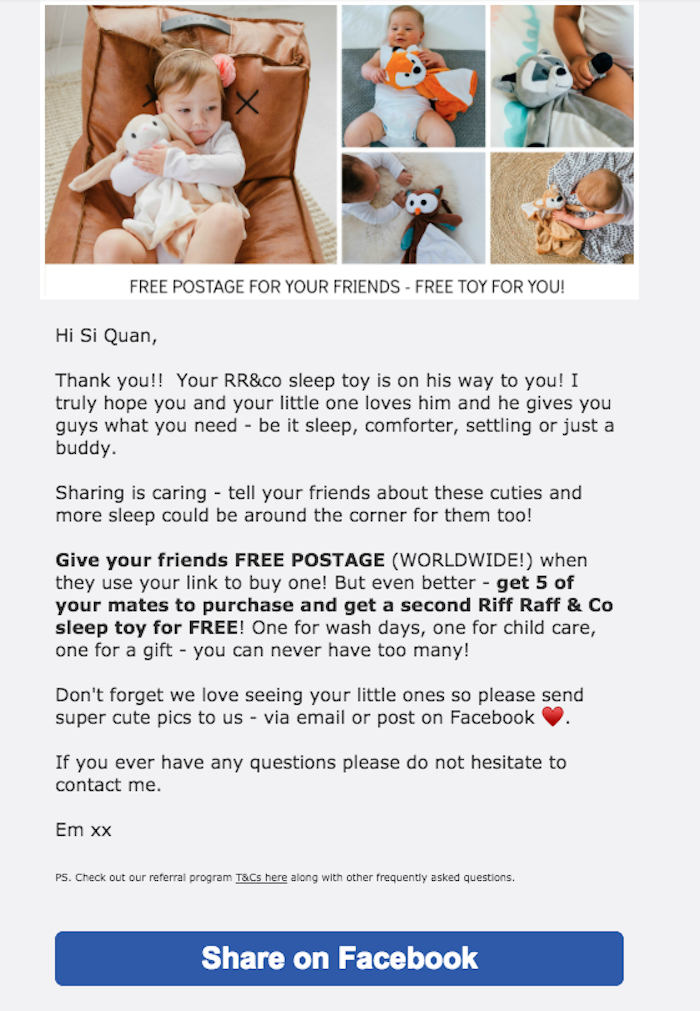
Riff Raff & Co is an ecommerce brand in the accessories for baby & toddler niche. Using the above referral email design, they achieved a 24% referral rate, much higher than the industry average. To create the referral emails, they used ReferralCandy.
Why we love this referral email example:
Email subject line: Refer friends and get $15
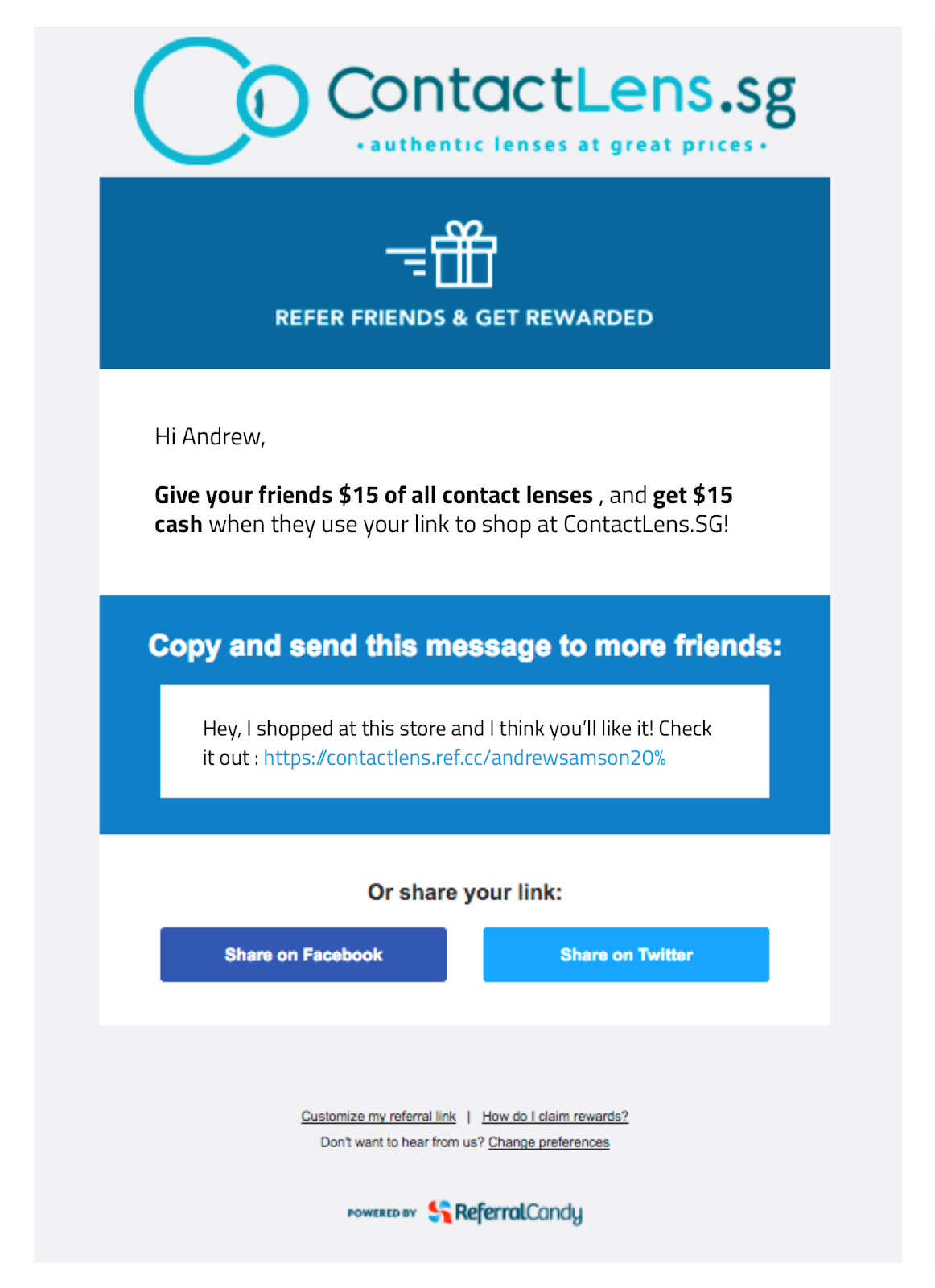
Contact Lens Singapore offers authentic contact lenses from brands like Bausch & Lomb, Alcon and Coopervision at up to 50% off recommended retail prices. They used ReferralCandy to launch their referral program, where referral advocates earn $15 directly into their PayPal account for each successful referral.
Why we love this referral email example:
Email subject line: Get 20% off for each successful referral

Evolve Skateboards designs and manufactures high-performance electric skateboards and accessories and is the industry leader in this category. Since launching their referral program with ReferralCandy, they have earned over $1M in referral sales and seen a 28x return on investment.
Why we love this referral email example:
Email subject line: Time To Share!
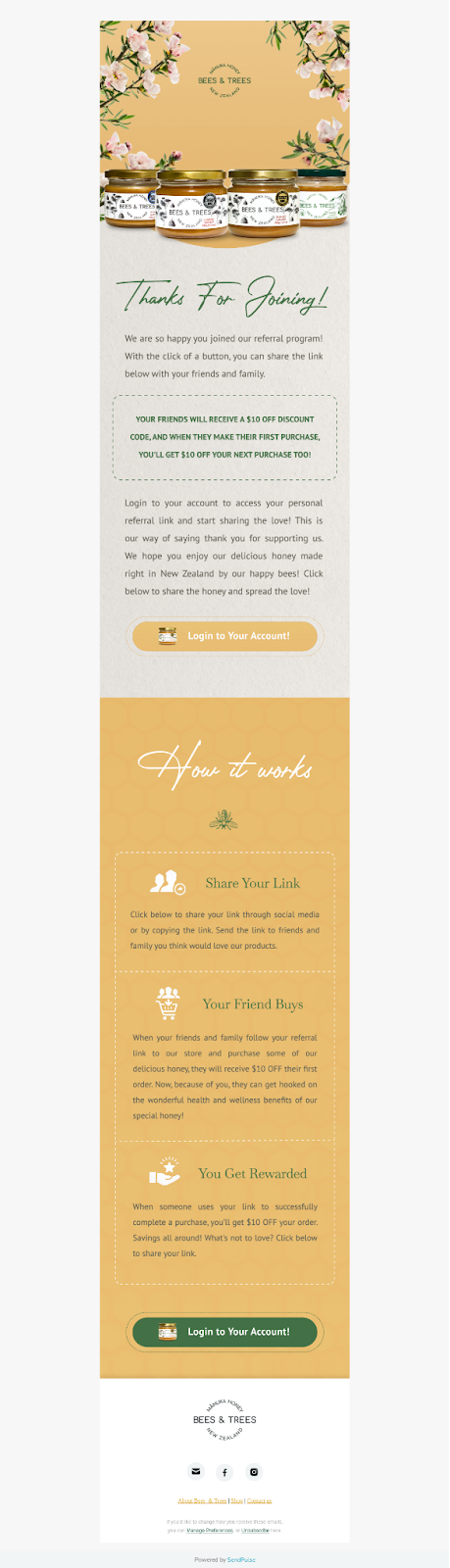
Bees & Trees is a brand that sells premium-quality honey, and other bee-related products like beeswax.
Why we love this referral email example:
Email subject line: Refer a friend and get $20 credit!
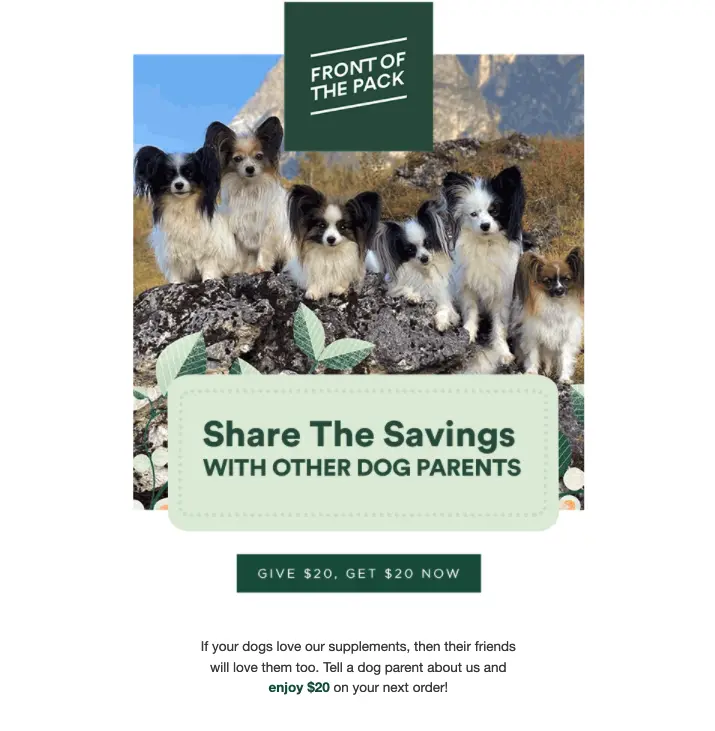
Front Of The Pack is a brand that specializes in pet health and wellness products.
Why we love this referral email example:
Email subject line: Give $5, get $5

Olipop is a brand selling beverages that are naturally sugar-free and aimed at providing healthy alternatives to traditional sodas.
Why we love this referral email example:
Email subject line: Discover. Save. Feel Better Every Day.
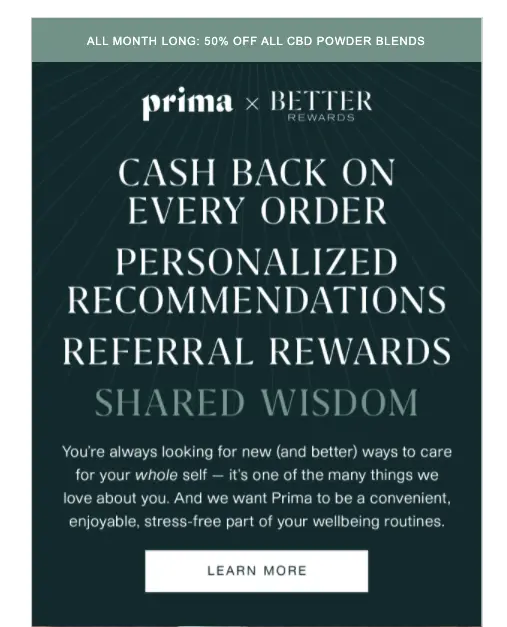
Prima is a wellness brand that offers a range of body care products.
Why we love this referral email example:
Email subject line: BLACK FRIDAY STARTS NOW
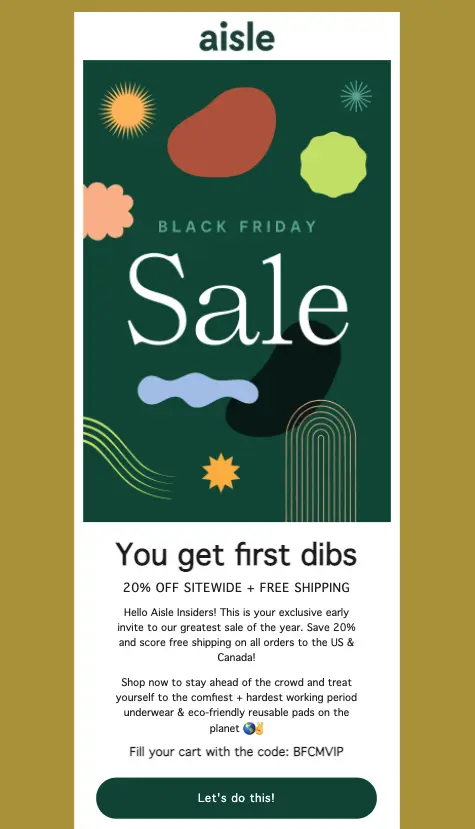
Period Aisle is a brand specializing in menstrual products, particularly reusable cups, pads, and underwear.
Why we love this referral email example:
Email subject line: International Day of Friendship

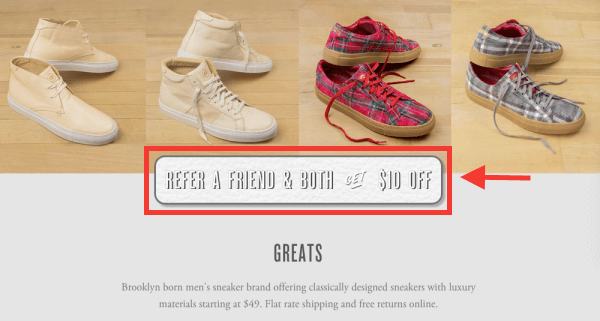
Greats is a footwear brand known for its stylish and high-quality sneakers.
Why we love this referral email example:
Email subject line: TRY NEW THINGS TOGETHER

Flexfits manufactures innovative menstrual products, such as menstrual discs.
Why we love this referral email example:
Email subject line: tell a friend about Recess for $10
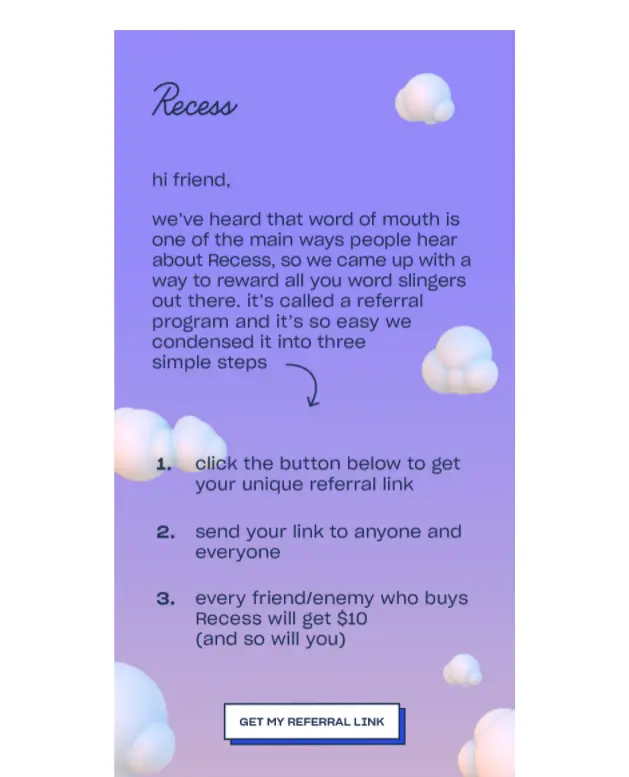
Recess is an ecommerce brand that promotes relaxation through its refreshing and healthy beverages.
Why we love this referral email example:
Email subject line: GIVE $20, GET $20
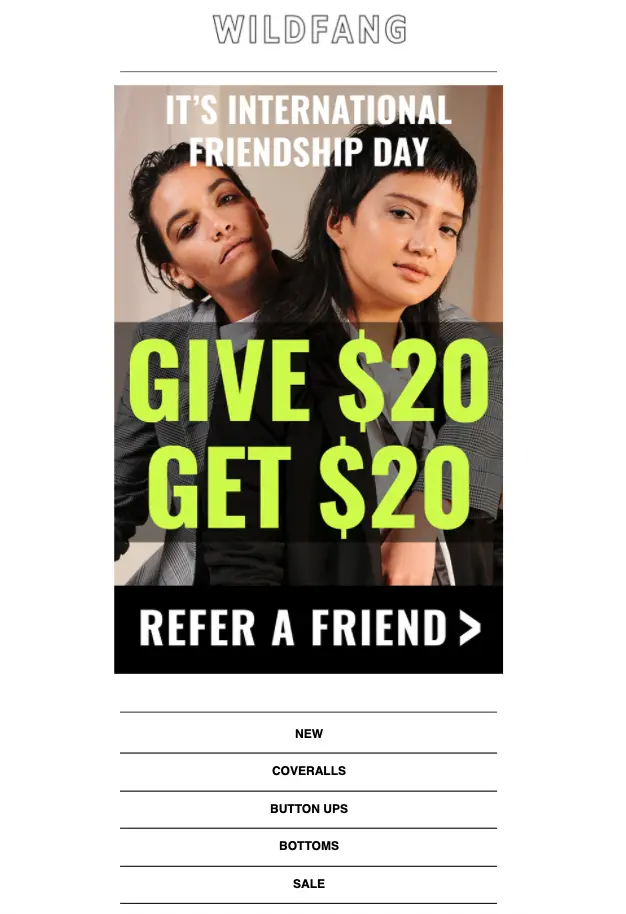
Wildfang is a fashion brand selling gender-neutral clothing and accessories.
Why we love this referral email example:
Email subject line: STARFACE REWARDS
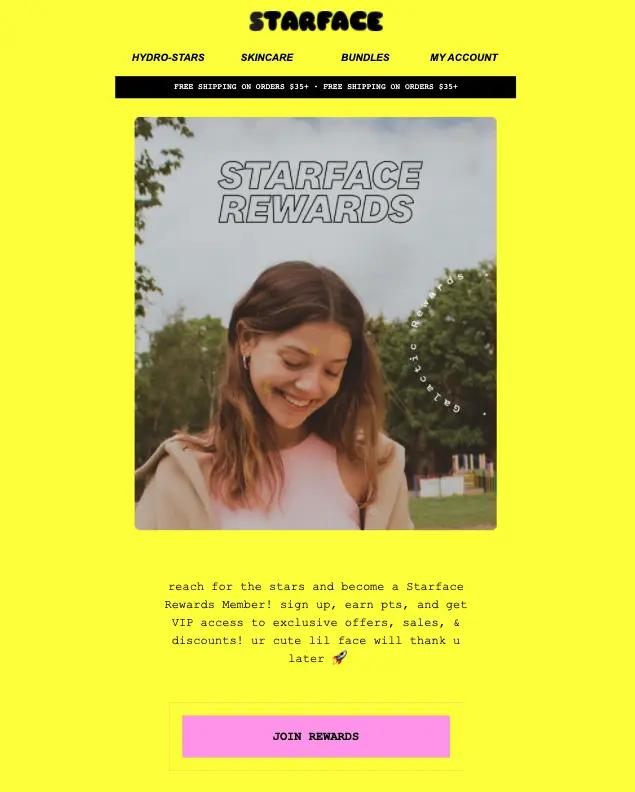
Starface is a skincare brand known for its innovative approach to acne treatment and skincare.
Why we love this referral email example:
Email subject line: Your $15 offer is expiring.
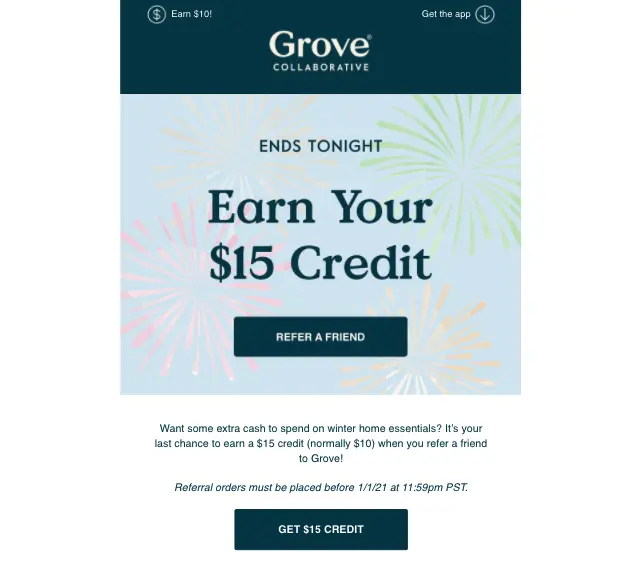
Grove is a brand specializing in sustainable household and personal care products.
Why we love this referral email example:
Email subject line: Sharing is caring! Refer a friend + get 20% off your next Bright Littles order!
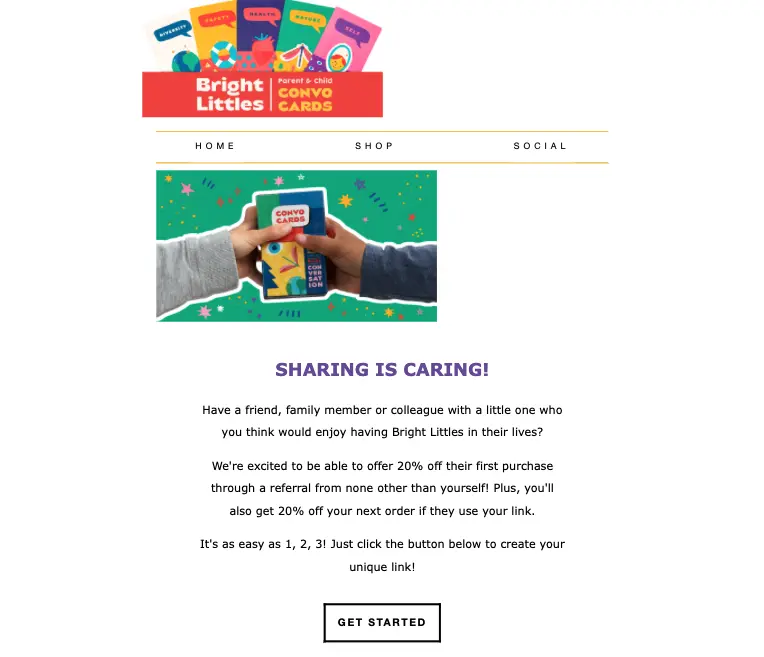
Bright Littles is an ecommerce brand selling conversation cards.
Why we love this referral email example:
Email subject line: This just in: The Green Impact Report

Cleancult is a brand that specializes in eco-friendly cleaning products, such as laundry detergent and household cleaners.
Why we love this referral email example:
Email subject line: Get $25 for each friend you refer
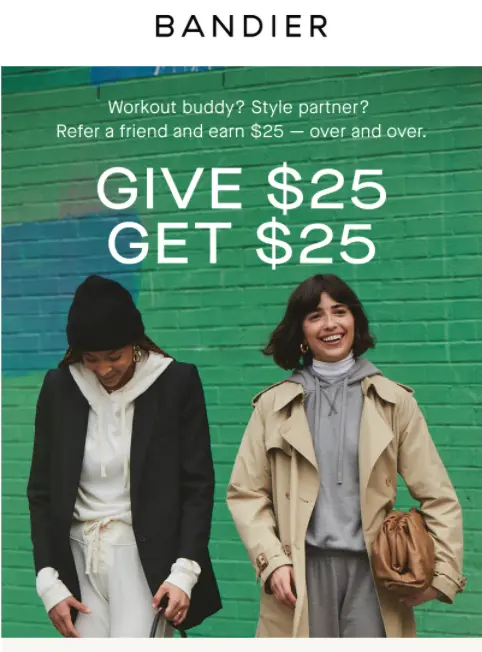
Bandier is an activewear brand that offers stylish workout clothing and accessories.
Why we love this referral email example:
Email subject line: Give the gift of vinyl, instantly 🎁
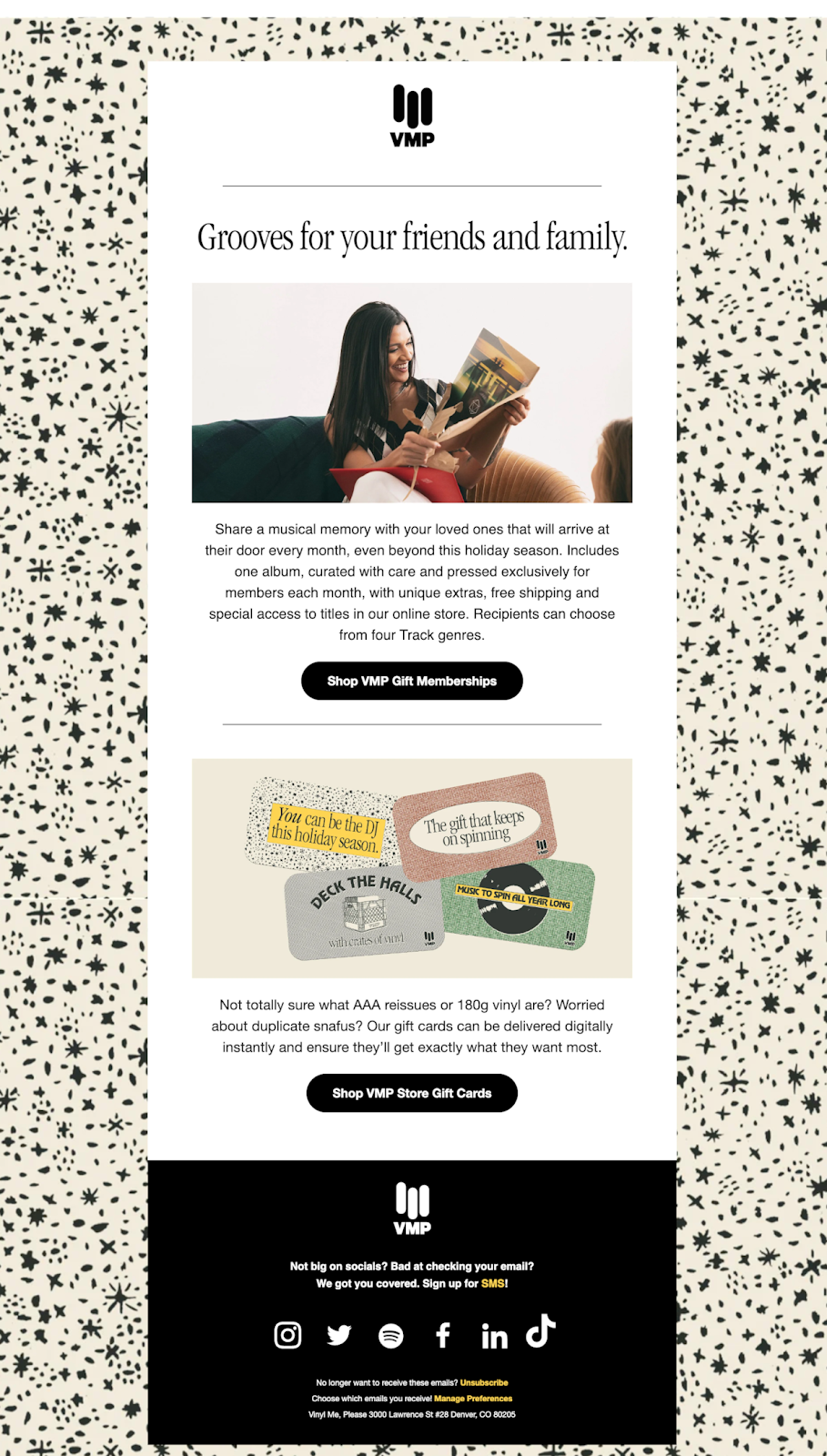
Vinyl Me, Please is a subscription-based service and online store specializing in vinyl records.
Why we love this referral email example:
Email subject line: GIVE $25, GET $25
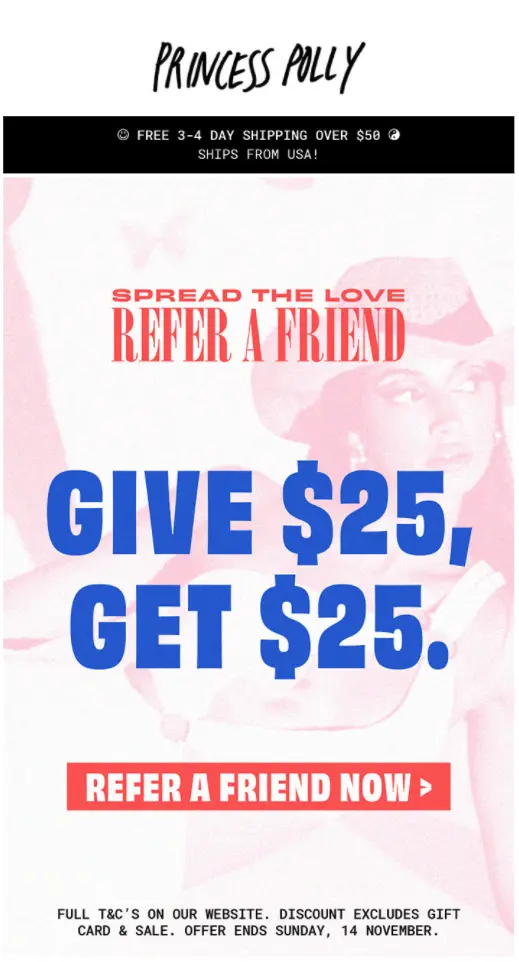
Princess Polly is a fashion brand that sells trendy clothing, accessories, and beauty products for women.
Why we love this referral email example:
Email subject line: This Won’t Last Long - Refer a Friend Today 🤝
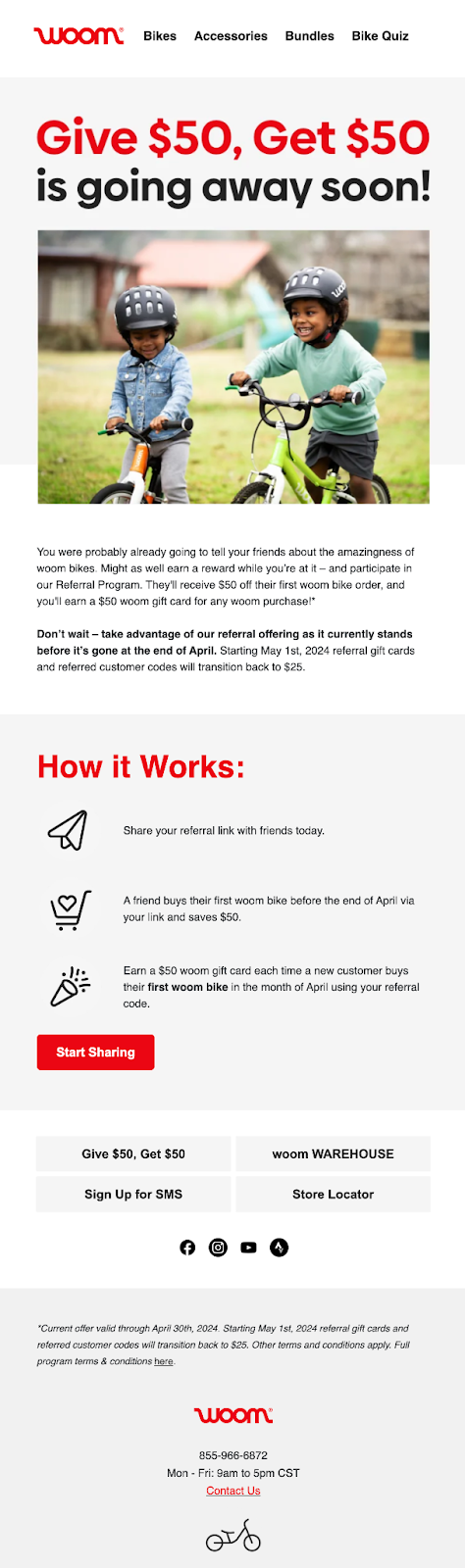
Woom is an ecommerce brand specializing in selling high-quality bicycles for children.
Why we love this referral email example:
Email subject line: Your Friends Will Thank You
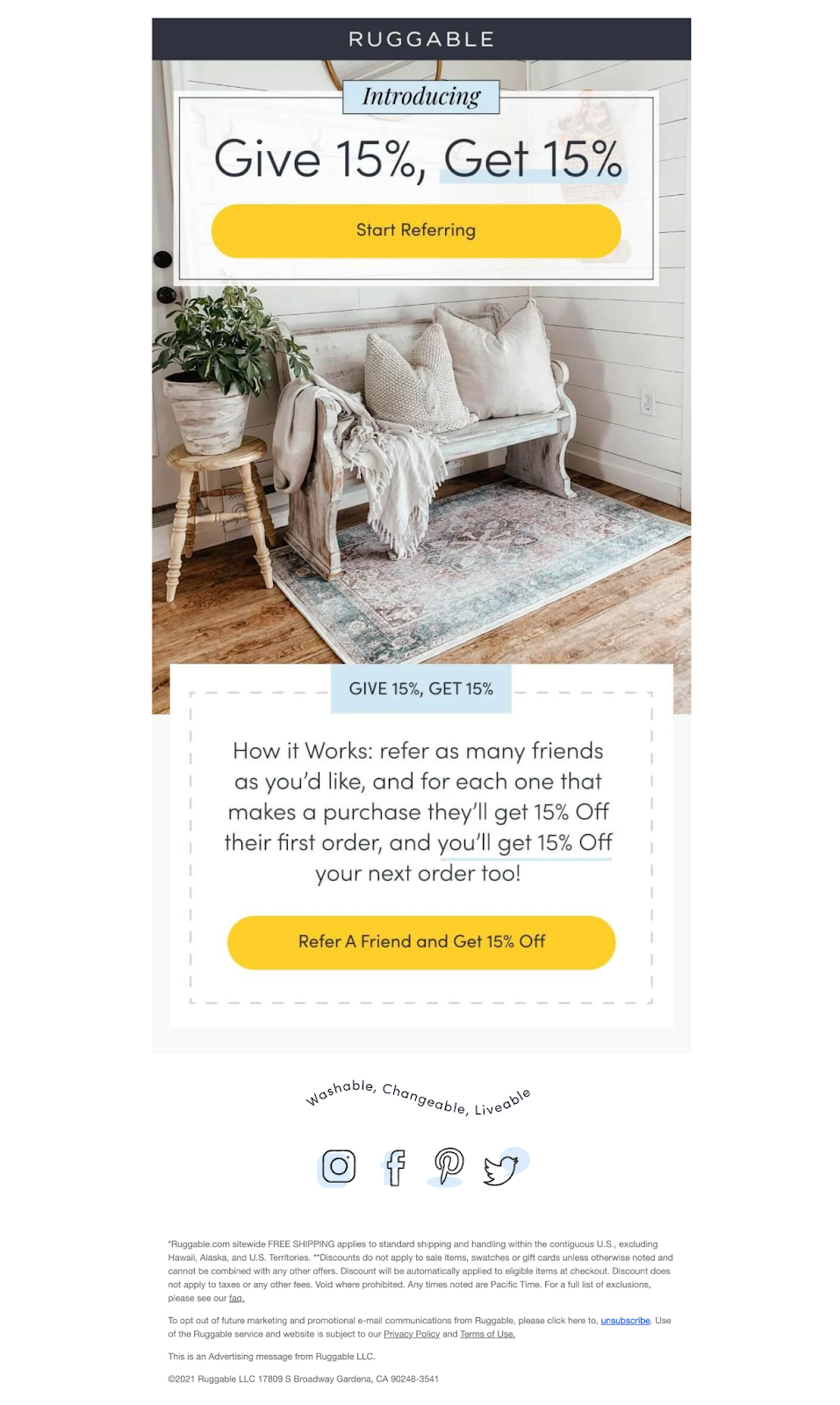
Ruggable specialises in selling machine-washable rugs designed for easy maintenance.
Why we love this referral email example:
Email subject line: Your Friends Will Want In On This…
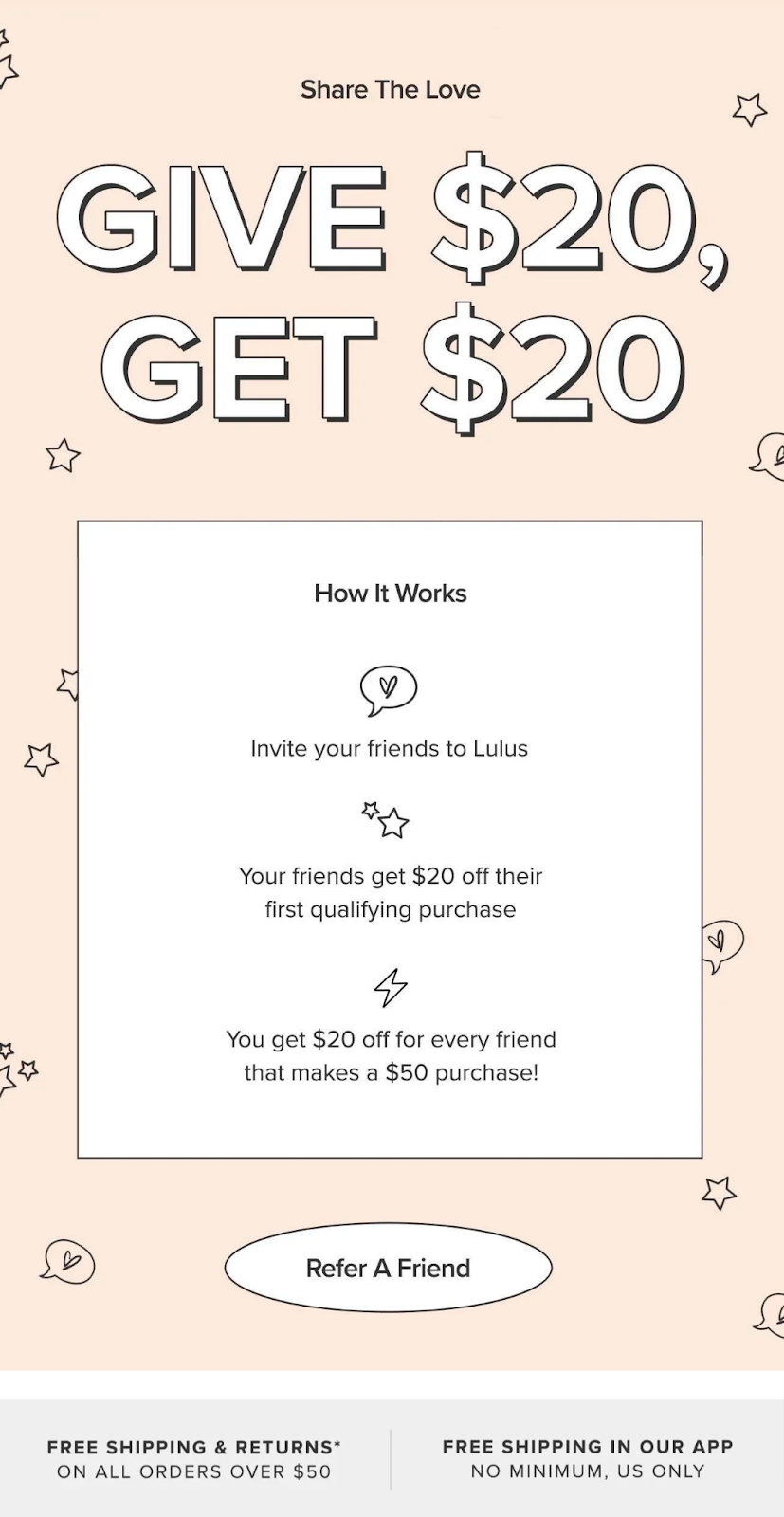
Lulus is a native fashion brand for women. The company is based in California and serves millions of customers worldwide.
Why we love this referral email example:
Email subject line: Earn 30% OFF for sharing VC! 💵✨
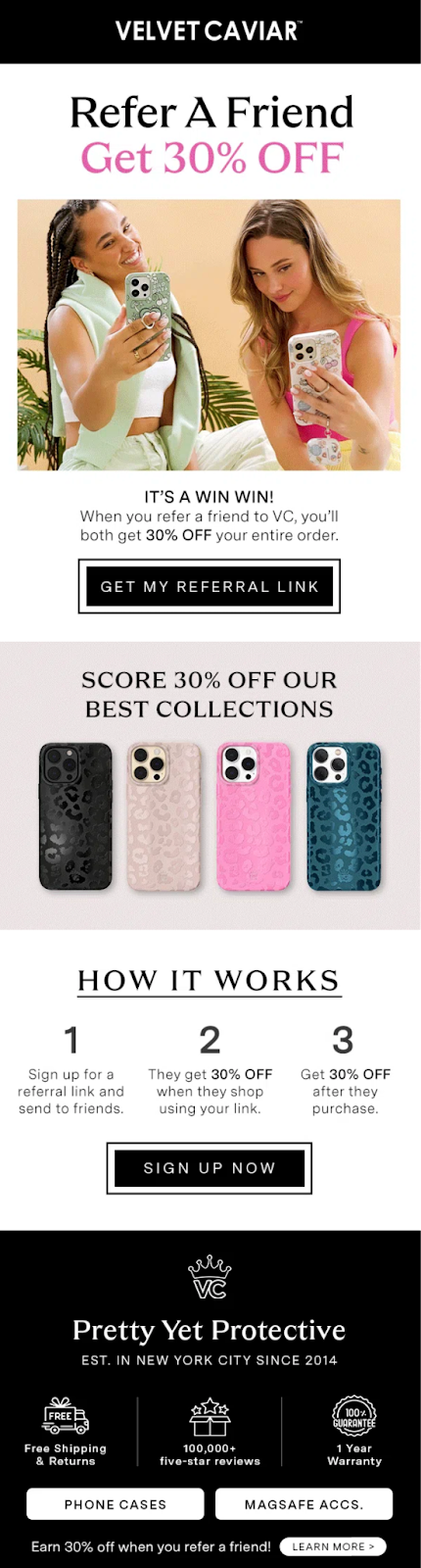
Velvet Caviar is an ecommerce brand selling phone cases, accessories, and tech gadgets.
Why we love this referral email example:
Now that we have seen some of the best referral email designs, let's look at three referral email templates you can use.
We have divided the templates into post-purchase, loyal customers, and informational referral email templates.
Remember that the below templates work best when accompanied by the right referral email design. To create beautiful referral email designs, you can use referral program software like ReferralCandy.
The most important step of any referral email campaign is to get the initial email out to the customers. A good way to do that is to send a post-purchase referral email to all new customers who order from you.
Post-purchase referral emails can be sent before customers even receive their orders, but the below template should be sent after they have received them.
Here is a template you can use:
Hey [Customer name],
Love your [product name]? Why not tell your friends about your experience?
When you refer a friend to [brand name], you'll both get [a specific percentage] OFF your entire order.
To get started, simply click the button below to create your own unique referral link!
[call to action button]
Customer loyalty refers to the customers who consistently choose your products over competitors. With this email, you can showcase your referral program and thank your loyal customers simultaneously.
Here is a template you can use:
Hey [Customer name],
We appreciate your continued trust in [brand] to [describe the problem you’ve solved for your customer].
You might have already told your friends about the amazingness of [product]. You might as well earn a reward while you're at it by participating in our referral program!
Your friend will receive [x amount of money] OFF their first order, and you'll earn a [x amount of money] gift card for any [brand] purchase!
To start referring to your friends, click on this link: [link to your referral program landing page]
Thank you for being a loyal customer,
[Your name]
An Informational referral email template is popular, especially when you've just launched your referral program. You can send it to inform your customers about the new referral program.
Here is a template you can use:
Become a [brand] Ambassador & Earn Cash!
Give your friends 20% off their first purchase of $65 or more and get $20 cash from [brand name] directly to your PayPal account!
The best part is you can refer as many friends as you wish, with the same reward each time.
Refferal orders must be placed before [specific date].
Forward this link to your friends:
[referral rewards program link]
Crafting a successful referral email can be difficult, so take as much time as you need in creating the best possible design and copy that will compel your customers to share with their friends and family.
Take inspiration from these 23 different email designs and make one that is truly your own.


.webp)
Discover the innovative Ecommerce Agency Industry Report by ReferralCandy, a monthly aggregated and anonymous report providing invaluable insights from ecommerce agencies worldwide. Dive into the latest trends, predictions, and the unique perspectives of ecommerce experts shaping the industry. Join this collaborative effort to understand the real-time sentiment and future directions of ecommerce. Be a part of the evolving ecommerce narrative with ReferralCandy's groundbreaking index.
To help merchants get more ecommerce referrals, we will share a detailed checklist that have been refined for years.
Creating a referral email campaign to promote your program? Here are examples of beautiful referral email designs from leading ecommerce brands so that you can draw inspiration from them!
Setting up a referral program should not be hard. Here's how you can do it in six steps and start getting referrals!
We've been running referral programs for thousands of ecommerce stores for over half a decade now, making retailers almost $470,000,000 in referral sales.

A referral program is a deliberate, systematic way of getting people to make referrals to your business. Referral programs are often called word-of-mouth marketing, because they reward existing customers for sharing and incentivize new customers to try out your brand.
What are the best Shopify themes available? Here are 30+ of the most reviewed Shopify themes for 2024 based on our research!
So you have a WooCommerce store, and you're looking to set up a referral program plugin. Well, you're in the right place as we have all the details here for you
Discover the top challenges faced by ecommerce founders in 2023 and unlock actionable solutions to propel your online business forward. Learn how to navigate these obstacles and optimize your ecommerce strategies for success.


.webp)


.webp)






.jpeg)



.jpg)
.webp)

.webp)


.webp)



.webp)

.webp)
.webp)


.webp)
.webp)


.webp)

.webp)
.webp)
.webp)

.webp)


.webp)


.webp)


.webp)



![Infographic: Why Referral Marketing is Awesome [2021 Update]](https://assets-global.website-files.com/6185b708a2657014268d2eaf/620498443877092dfe557e88_why-referralmarketing-is-awesome-featured.jpeg)





.jpeg)










![Has Ecommerce in the U.S. become saturated? [Infographic]](https://assets-global.website-files.com/6185b708a2657014268d2eaf/620494ae6710a7c53a147471_ecommerce-saturated-featured1.png)


.webp)
.webp)


.webp)